2. Background and Related Work
2.1 Introduction
This chapter presents the background research done to develop CONNECT and share. It covers:
- Interactive urban light installations: Public art installations that respond to human presence in real time, where strangers collectively shape a shared visual environment through light and colour.
- Community stories: Projects that use everyday technology to connect strangers in a shared space through participation and co-creation.
- Participatory public art: Research into design principles that create a sense of connection between strangers in shared spaces.
- Research: Academic studies and technical documentation covering loneliness in urban environments, velostat as a pressure-sensing material, the ESP32 microcontroller family, CAN bus communication and addressable LED components.
- Comparative analysis: A structured overview of the products, installations, and sources reviewed in this chapter, summarising their relevance to CONNECT and share.
2.2 Products
2.2.1 Interactive urban light installations
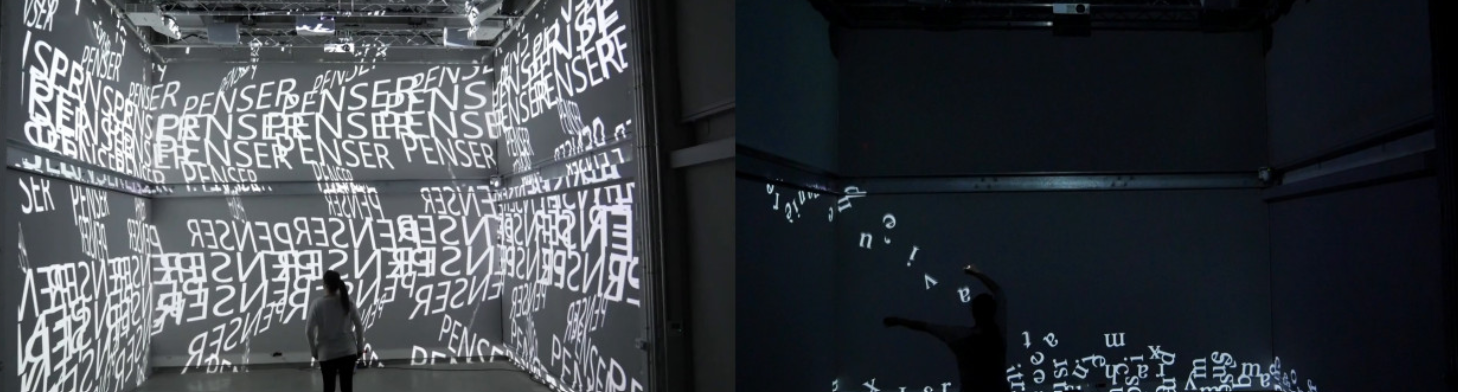
Kinetic particles is an interactive art installation that connects human physical movement with digital projections [1]. By using cameras and deep learning technology, the system tracks the body movements of performers and audience members in real-time, as illustrated in Figure 1. This tracking data is then used to control words and letters that are projected onto the walls of the room. When people move, their gestures (like the speed of their wrists) act like a force that pushes the projected text around, turning the words into moving particles. The project is designed to be an immersive experience where multiple people can explore the connection between their physical actions and the digital environment, allowing them to collaborate and interact with each other. This article is highly relevant to our research because both projects use technology to create a shared, physical experience rather than isolating people. In the “Kinetic particles” installation, multiple spectators can simultaneously interact with an immersive digital environment. The authors note that this collective setup invites people to collaborate and synchronize their movements. This directly connects to our idea of blending passengers' light colors in the metro. Additionally, the project demonstrates that giving intuitive, real-time visual feedback based on physical actions creates a lively and organic interaction. We can use these findings as proof that interactive design can effectively pull people out of their digital bubbles and connect them with strangers.
2.2.2 Community stories
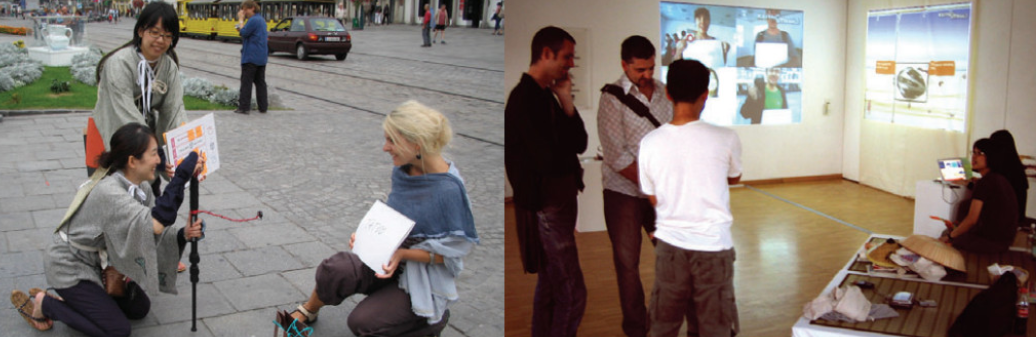
This article describes the project Keitai Trail in which researchers used mobile phones to collect and link personal stories from people in public spaces [3]. During an art festival, the researchers made a workshop, seen in Figure 2. Here participants recorded short videos based on a specific question-and-answer game. Each person answered a question from a previous participant, shared a short story, and then posed a new question for the next participant. All these connected stories were then projected onto a large screen so that participants could view the entire network of videos. The aim was to change users' mindsets by using everyday mobile phones as creative means of expression rather than just for one-way communication [4].
This research is relevant to our project because it demonstrates how technology can be used to collect stories from strangers and connect them in a shared environment. Similar to our concept with QR codes and anonymous messages in the underground, this project utilise an everyday device to lower the threshold for participation and capture human experiences in an “expression mode”. The authors show that providing a clear structure, such as answering a question from a predecessor, acts as an incentive to help people share their thoughts. Furthermore, making these connections visible helps participants understand that their own story has an impact on the bigger picture and that they are part of the world around them. We can use this insight to substantiate that our installation and web application featuring messages will indeed offer travelers a sense of community and connection.
2.2.3 Participatory Public Art
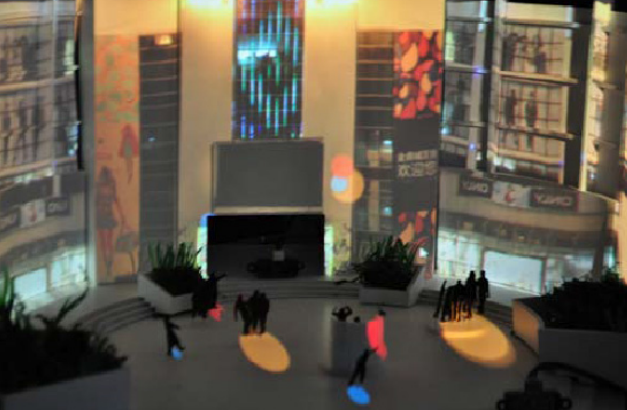
This article outlines the evolution of materials used in public art and how new technologies have led to interactive and participatory installations [6]. The authors categorize art forms into static, dynamic, interactive, and participatory levels. In participatory forms, artists do not just create a final object; they design a platform that grows through the creative input of the public. The paper highlights several design cases to illustrate this concept. One example is “Strijp-T-ogether”, an installation designed for a creative industrial area. It uses a mobile app where users can draw or add graphics to a photo of the main hall. These additions are then projected into the physical space and appear on other users' phones, encouraging people to react to each other's drawings and stimulating social interaction among individuals from different companies (see Figure 3). Another example, “Leave Your Mark”, uses projection mapping and a live camera feed to connect two different locations in a city, allowing a person walking by to see a stranger “drawing” on the installation elsewhere, aiming to increase feelings of inclusion and connectedness. This article is relevant to CONNECT and share because it provides a theoretical framework for participatory public art. The examples demonstrate that combining a physical environment with a digital, co-creative layer can foster social interaction between strangers in a shared space. This supports the argument that CONNECT and share's approach, where passengers collectively shape a visual environment through touch follows an established design principle for creating a sense of shared presence.
While these installations demonstrate how interactive systems can foster shared experiences, they rely on large-scale sensing technologies such as cameras and projection systems. In contrast, CONNECT and share translates these principles into a distributed embedded system suitable for a metro environment, using touch-based sensing, microcontrollers, and LED feedback.
2.3 Research
2.3.1 Loneliness in public spaces
A central motivation behind CONNECT and share is the observation that people in dense urban environments such as metro carriages, often feel more disconnected from those around them, not less. This paradox is supported by the research article “Lonely in a crowd” [8], who investigated the real-time relationship between loneliness and the social environment, published in Scientific Reports. Using a smartphone-based assessment method, 756 participants across multiple countries reported their momentary feelings of loneliness up to three times daily over 14 days, alongside observations about their immediate environment [9].
The study found that perceived overcrowding was positively associated with loneliness (OR: 1.39), meaning that being surrounded by many people did not reduce feelings of isolation, it increased them. In contrast, perceived social inclusivity, defined as feeling welcome, feeling that others would help you, and sensing shared values with those nearby, was significantly associated with lower loneliness (OR: 0.79). Contact with nature similarly reduced loneliness (OR: 0.72), and the two effects amplified each other when combined [10].
The findings from this study highlights the problem we want to solve with our project. They suggest that placing people in proximity to one another is not enough to create a sense of belonging, what matters is whether people feel acknowledged and included by those around them [11]. We aspire to address this by creating a shared experience that makes the presence of fellow passengers visible and meaningful, without requiring explicit social interaction. Rather than demanding conversation or eye contact, it uses light as a medium to signal to passengers that they are part of a collective moment.
It should be noted that the study has limitations. The sample was self-selected and the main participants was educated, middle-aged, Caucasian participants, which limits how broadly the findings can be generalized. Loneliness was also measured with a single survey item, and the study is observational, meaning the associations found do not establish causation. Still, the core finding, that overcrowding increases loneliness while perceived inclusivity reduces it, provides a meaningful theoretical basis for our project.
Despite these limitations, the finding by Hammoud et al. that perceived overcrowding increases loneliness (OR: 1.39) while inclusivity reduces it (OR: 0.79) directly shaped CONNECT and share’s output design. We operationalized this by projecting color across the shared ceiling rather than limiting feedback to a single pole, ensuring each passenger's presence is visible to the entire carriage.
2.3.2 Microcontroller
The decision to use a microcontroller from the ESP32 family is supported by a comparative analysis of microcontroller platforms for the Internet of Things (IoT) and embedded systems [12]. The study evaluates the ESP32 against comparable boards and concludes that its combination of low cost, low power consumption, and compatibility with the Arduino development environment makes it well suited for sensor-driven embedded applications.
In CONNECT and share, the system is distributed across two types of nodes: sensor nodes embedded in each handrail pole, and a central ceiling node that drives the LED strip. Each node handles one task: either reading pressure input from the velostat sensor, or sending colour signals to the LED strip. A single-core microcontroller is sufficient for this, as no parallel processing is required at the node level. The ESP32 microcontroller can handle multiple tasks simultaneously [13], which is not necessary for our project. Therefore we use the WEMOS mini, a development board based on the ESP32-C3 is used for this. It is a single-core RISC-V variant in the ESP32 family. This was chosen due to its compact form factor and lower power consumption compared to the dual-core original [14].
The Arduino-compatible development environment shared across the ESP32 family is a practical advantage for our multidisciplinary student team, as it is «beginner-friendly» and have several libraries for both sensor input and LED control [15].
Maier et al. confirmed that the ESP32-C3 offers sufficient processing capacity for single-task embedded nodes at low power. In CONNECT and share, each Sensor Node performs only ADC polling and CAN transmission, while the Central Node only processes incoming CAN frames and drives LED output. No parallel processing is required at either node, making the single-core WEMOS C3 Mini the appropriate and cost-effective choice.
2.3.3 Velostat sheet
The decision to use velostat sheets for touch detection in the handrails of CONNECT and share is grounded in established research on flexible piezoresistive materials. Velostat is a polyethylene-carbon composite material that changes its electrical resistance in response to applied pressure. When compressed, the resistance decreases, producing a measurable electrical signal [16] Dzedzickis et al. evaluated the mechanical and electrical characteristics of velostat as a tactile sensor material, testing it under static, long-term, and cyclic load conditions.
The results confirm that velostat produces consistent, repeatable signals across multiple loading cycles, and that it can be implemented using a simple electrode pair [17]. These properties make it well suited for CONNECT and share, where the sensor must reliably detect the pressure of a passenger gripping a handrail and produce a signal the ESP32 can read.
A practical advantage of velostat for this application is its flexibility. The material is thin and can conform to curved surfaces such as a handrail without requiring rigid mounting. One limitation noted in the research is that velostat's response is not perfectly linear and may drift slightly under repeated use [18]. To account for this, the sensor node includes a 10 kΩ potentiometer that allows the sensitivity to be manually adjusted during prototyping until reliable detection is achieved.
Velostat is not perfectly linear and its sensitivity shifts with repeated use, as Dzedzickis et al. documented under cyclic loading conditions. The Sensor Node PCB addresses this directly: a 10 kΩ potentiometer on the board lets the sensitivity threshold be tuned physically during installation, without touching the firmware, which matters when grip pressure varies significantly between passengers.
2.3.4 CAN Bus and MCP2551 transceiver
CONNECT and share uses a distributed node architecture: each handrail pole contains an independent sensor node, and a central node at the ceiling receives their signals and controls the LED strip. Coordinating these nodes requires a communication protocol that can handle multiple transmitters on a shared line and remain reliable in an electrically noisy environment.
CAN (Controller Area Network) is a serial communication protocol originally developed for automotive applications, where multiple electronic control units must communicate reliably despite high levels of electrical interference [19]. It is standardised under ISO 11898 and is widely used in embedded systems beyond the automotive industry, including industrial and building automation contexts [20]. Of particular relevance to Connect is CAN’s use of differential signalling: the bus carries each signal across two lines with opposite voltages, so interference affects both lines equally and is cancelled out at the receiver [21]. This makes CAN significantly more robust against electromagnetic noise than single-ended alternatives, which is important in the context of a metro carriage.
The MCP2551 is a high-speed CAN transceiver developed by Microchip Technology that implements the physical layer of the ISO 11898 standard [22]. It acts as the interface between the microcontroller's digital Transmit (TX) / Receive (RX) pins and the differential CAN bus line. One unit is placed at each node both the sensor nodes in the poles and the central ceiling node.
A metro carriage is electrically hostile. Traction motors and power converters produce continuous EMI that would corrupt single-ended protocols like Inter-Integrated Circuit (I2C) or Universal Asynchronous Receiver-Transmitter (UART). Bozdal et al. document exactly this weakness in non-differential bus architectures, which is why Connect uses CAN throughout.
2.3.5 WS2812B addressable LED strip
The WS2812B is an individually addressable RGB LED component that integrates the control circuit and the RGB emitter into a single 5050-format package [23]. Each unit contains a built-in driver IC that receives colour data, applies it to its own output, and passes the remaining data to the next unit in the chain via a single data line. This daisy-chain architecture means the entire ceiling strip can be controlled from one digital output pin on the microcontroller [24].
Individual addressability is essential for CONNECT and share's core interaction: each passenger's contact with a handrail must produce a distinct colour that travels visibly up the pole and merges with others across the ceiling. The WS2812B supports 256 brightness levels per colour channel, giving a total of approximately 16.7 million possible colours [25].
The strip is compatible with the FastLED library available in the Arduino development environment, which is consistent with the microcontroller platform used across the rest of the system.
CONNECT and share consists of multiple distributed sensor nodes embedded in handrails, each detecting passenger interaction through velostat sensors. These nodes communicate via a CAN bus network to a central controller located in the ceiling, which drives an addressable LED strip to visualise collective interaction.
The component review above evaluated the WS2812B. During implementation, the project adopted the WS2813, an enhanced variant that adds a redundant backup data line, so a single failed LED does not interrupt the rest of the strip. All subsequent hardware, power, and prototype sections refer to this part.
2.4 Comparative analysis
The sources reviewed in this chapter fall into two groups: installations and products that are relevant to the design of Connect, and research or technical literature that informs the component choices. These are summarised in table 1 and table 2.
The three installations in 1 each highlight something relevant to Connect. Kinetic Particles shows that giving people real-time visual feedback based on their physical actions can pull them into a shared experience. Keitai Trail shows that people are more willing to participate when the interaction uses something familiar, like a phone. Strijp-T-ogether is the closest to what Connect is trying to do: it shows that adding a co-creative digital layer to a physical space can get strangers to interact in a meaningful way.
In 2, the study by Hammoud et al. is the main theoretical motivation for the project. It shows that being surrounded by people does not make you feel less lonely, what matters is whether you feel noticed and included. The other entries in the table are more technical. Maier et al. informed the choice of microcontroller platform, Dzedzickis et al. supports the use of velostat for detecting grip pressure, and Bozdal et al. explains why CAN bus is a good fit for a system that needs to stay reliable in an environment with a lot of electrical noise. The MCP2551 and WS2812B datasheets document the specific components used for the CAN bus connection and the LED output.
| Category | Technology/Medium | Interaction Type | Core Focus | Relevance to Connect |
|---|---|---|---|---|
| Kinetic Particles | Cameras, deep learning, digital projections | Real-time physical movement | Connecting physical movement with a digital environment | Proves that real-time visual feedback pulls people out of their digital bubbles |
| Keitai Trail | Mobile phones, large projection screens | Asynchronous (recording Q&A videos) | Collecting and linking personal stories | Supports the use of everyday devices to foster a sense of community |
| Participatory Installations (Strijp-T-ogether) | Mobile apps, projection mapping, live camera feeds | Real-time and asynchronous digital co-creation | Stimulating social interaction through a shared platform | Provides a theoretical framework for passengers co-creating their metro environment |
| Category | Method | Key Finding | Relevance to Connect |
|---|---|---|---|
| Hammoud et al. – Lonely in a Crowd | Smartphone-based ecological momentary assessment | Overcrowding increases loneliness; perceived inclusivity reduces it | Confirms the problem Connect aims to address |
| Maier et al. – ESP32 | Comparative analysis of microcontrollers for IoT | ESP32 family offers low cost, low power consumption, and Arduino compatibility for embedded applications | Justifies the choice of the WEMOS C3 mini for the sensor and ceiling nodes |
| Dzedzickis et al. – Velostat | Mechanical and electrical testing under static, long-term, and cyclic load conditions | Velostat produces consistent, repeatable signals and can be implemented with a simple electrode pair | Justifies the use of velostat sheets for pressure detection in the handrails |
| Bozdal et al. – CAN Bus | Survey of CAN protocol properties and security | CAN's differential signalling provides strong immunity to electrical noise and interference | Justifies the use of CAN bus for communication between nodes in a metro environment |
| Microchip Technology – MCP2551 | Component datasheet | Implements the ISO 11898 physical layer, acting as the interface between microcontroller and CAN bus | Justifies the choice of transceiver for each node in the system |
| WorldSemi – WS2812B | Component datasheet | Individually addressable RGB LED with integrated driver, controllable via a single data line | Justifies the choice of LED component for producing distinct, blendable colours on the ceiling |
2.5 Summary
This chapter has reviewed existing installations, research, and technical literature relevant to CONNECT and share. Kinetic Particles and Strijp-T-ogether demonstrate that physical interaction driving real-time visual feedback can create a genuine sense of shared presence between strangers, while Keitai Trail shows that lowering the participation threshold through familiar everyday actions produces stronger community engagement. Both observations informed the two-phase structure of CONNECT and share: immediate ambient light response in Phase 1, and the web application where passengers can send messages anonymously in Phase 2.
Hammoud et al. establish the social motivation: that one needs to feel engaged with people around you to reduce the feeling of loneliness. That finding provide more than context for CONNECT and share, it is the reason the light output targets the shared ceiling rather than the individual pole, and why the blending of multiple passengers' colors is the central mechanic rather than a secondary feature.
The technical decisions is backed by research. Velostat handles pressure detection in the handrails because it is flexible, consistent under cyclic load, and manageable despite its non-linearity through the on-board potentiometer. CAN handles inter-node communication because the metro's EMI environment makes single-ended protocols unreliable. The WEMOS C3 Mini handles local processing because the node tasks are simple enough that a single-core microcontroller is sufficient and lower power. The WS2812B handles ceiling output because individual addressability from one data line maps directly onto the distributed node architecture.
In the next chapter the team’s work regarding project management is accounted for.