4. Marketing Plan
4.1 Introduction
This chapter outlines the formulation of the business idea and the strategic marketing approach developed to bring CONNECT and share to the market.
It covers:
- Business Idea Formulation: Definition of the core concept, outlining the multisensory value proposition, and establishing the problem-solution fit to combat digital isolation on public transport.
- Business Model: Identification of both B2B (public transport authorities) and B2C (daily commuters) target markets, alongside the differential value of a zero-friction interactive experience.
- Market Analysis: A comprehensive evaluation of the macro-environment using the PESTEL framework to assess the Political, Economic, Social, Technological, Environmental, and Legal factors influencing the project.
- SWOT Analysis: A structured assessment of the project's internal strengths and weaknesses, combined with external market opportunities and threats.
- Strategy: The strategic roadmap detailing the segmentation and targeting of Young Urban Commuters, and how the project is positioned against passive digital consumption.
- Marketing-Mix & Brand: The application of the 4 Cs framework (Customer value, Cost, Convenience, Communication) to center the user perspective, and the definition of CONNECT and share's core values and brand personality.
- Marketing Programmes: The planned marketing initiatives, budget allocation, and control mechanisms required to execute the strategy.
- Summary: The final conclusions that justify the product's market fit and bridge the strategic decisions to the next phase of development.
The traditional aim of marketing is to identify and meet the needs of consumers in a way that creates value and builds long-term relationships. For the CONNECT and share project, however, we specifically apply the principles of social marketing. Social marketing uses marketing knowledge and techniques to achieve social goals, with the benefits primarily accruing to the target group or society as a whole, rather than solely to the seller.
CONNECT and share transforms the monotonous daily commute on public transport into an interactive experience that breaks through the modern-day ‘digital bubble’. Using sensors and LED lighting, we turn a routine journey into a multi-sensory experience that reconnects people with the real world. For the CONNECT and share project, we apply the principles of social marketing, which focuses on influencing voluntary behavior to improve societal welfare rather than just building awareness [1].
4.2. Business Idea Formulation
To successfully bring our vision to market, we place the traveller’s needs at the very heart of our design process. According to the core concept of marketing, everything revolves around identifying and fulfilling customer needs. Our Business Idea Formulation therefore starts with a sharp analysis of a current social pain point, to which we propose a solution that is not so much a ‘product’ as one that delivers tangible, emotional value.
4.2.1 Problem-Solution Fit
- The Problem: Shared transport has nowadays become a space of digital isolation and social disconnection. Passengers avoid eye contact, and excessive screen use contributes to stress, passivity and mental fatigue.
- The Solution: CONNECT and share breaks through this isolation in an accessible way. As soon as a passenger holds onto a handrail in the metro (an everyday and necessary action), a personal light colour travels to the ceiling, blending with the colours of other passengers. To continue this shared experience outside the metro, a QR code at the exit allows passengers to exchange anonymous messages, about life lessons. An intentional delay, whereby passengers can read the messages after their journey, ensures that they remain in the moment and away from their screens during the journey.
4.2.2 Value Creation
A fundamental principle in marketing is that customers do not buy products, but benefits [2]. CONNECT and share focuses strongly on the emotional dimension of brand value and creates profound emotional benefits for the user. We maximise Perceived Value by offering a moment of calm and human connection in what is typically a stressful environment. Our value proposition rests on three pillars: - Sensory Grounding & Visualisation: Solitary scrolling is replaced by a real-time visual representation of human connection, where the user’s touch translates into streams of light.
- Zero-Friction Socialising: Strangers are connected through a simple action without the need for screens or phones during the journey.
- Active Co-creation & Emotional Exchange: Passengers transform from passive travellers into active co-creators of their physical environment (lights) and digital community (messages).
4.2.3 Optimal Value Proposition
A successful market offering requires an Optimal Value Proposition (OVP) based on the 3-V framework, which means it must create superior value for the three core entities in the market:
- Customer Value (The Passenger): We increase value for the customer by responding to emotional needs. Passengers experience moments of wonder, intimacy and a sense of connection without having to make any extra effort.
- Collaborator Value (Metro do Porto & Sponsors): We create superior value for our key partners (Collaborators), such as Metro do Porto, by humanising their infrastructure and significantly improving the customer experience. This leads to higher customer satisfaction, stronger brand loyalty and an innovative image as a forward-thinking ‘Smart City’ solution.
- Company Value (Our Team/Company): The project creates value for us as an organisation by positioning us as pioneers in ethical, well-being-focused urban technology. This opens doors to future scalability, grants and B2G collaborations.
4.3. Business Model
To access the Big Idea Canvas please follow this link.
A Business Model Canvas has been drawn up to define the value of CONNECT and share. This strategic tool provides a clear visualisation of how the project generates, delivers and captures value from two main perspectives:
- Passenger experience and social impact
- Logistics, engineering and infrastructure
CONNECT and share’s business model operates within a hybrid Business-to-Government (B2G) and Business-to-Business (B2B) structure. To understand how we exchange value, we apply the “6-V Framework” (Value Exchange). This model identifies the key entities in the target market: customers, the company, collaborators and competitors. Within CONNECT and share, this is closely linked to Relationship Marketing: our aim is to build meaningful, long-term relationships with both our users and our partners in the wider marketing environment.
4.3.1 Customer Segments & Relationships
Our target group (Customer Segments) consists mainly of “The Digital Exhausted” (young, urban commuters aged 18–45), regular travellers and city enthusiasts. The relationship we build with them (Customer Relationships) is not transactional, but revolves around active co-creation and a shared sense of urban connectedness. The channels (Channels) used to reach them are primarily direct and tactile (via the sensors in the handrails) and then digital (via the QR codes in the underground stations).
4.3.2 Primary Exchange Relationship & Object Pillar
To understand CONNECT and share as a brand, we use Paulo Lencastre's Brand Triangle [3], which looks at a brand from three angles: identity, object, and response.
- The Identity Pillar covers what the brand looks and feels like — the name, the flowing light patterns on the ceiling, and the minimalist QR interface.
- The Object Pillar is the actual exchange offered: an interactive installation that improves the passenger experience, in return for infrastructure access and financial support from partners like Metro do Porto.
- The Response Pillar is about perception: the emotional associations we want to build with passengers and partners. We want CONNECT and share to feel warm and human.
Each of these pillars is developed further in Section 4.6.5.
4.3.3 Revenue Streams and Cost Structure
The logistics, engineering and infrastructure entail a Cost Structure, including the production of hardware kits (sensors, microcontrollers), installation, and crucial maintenance (where protection against and repair following vandalism plays a key role). However, the financing is not borne by the end-user. Instead, we generate revenue through the following revenue streams:
- B2G Contracts: Service fees paid by public authorities, such as Metro do Porto, for improving the User Experience (UX).
- Corporate Sponsorships (B2B): Revenue from socially responsible brands wishing to promote themselves in relation to mental wellbeing and social impact.
- Urban Social Analytics: Providing anonymised reports on urban wellbeing and sentiment to city councils.
- Grants: Financial support from cultural or innovation funds focused on urban social dynamics.
Figure 1 maps out the hybrid Business-to-Government and Business-to-Business aproach, ensuring the project's sustainability within the Porto Metro ecosystem.

4.4. Market Analysis
A successful marketing strategy must always be grounded in a thorough market analysis. To shape our strategy, we analyse the marketing environment: the external factors and forces that influence our ability to build and maintain successful relationships with our target audience. This environment is divided into the macro-environment and the micro-environment.
4.4.1. Macro-environment (PESTEL Factors):
The Macro-environment consists of the broader societal forces that influence the Micro-environment. To systematically examine these external variables and anticipate challenges and opportunities, we use a Political, Economic, Social, Technological, Environmental, Legal (PESTEL) analysis, a widely recognized tool to categorize macro-environmental drivers of change [4].
By identifying these factors, we can anticipate potential challenges and see the opportunities. Figure 2 provides a summary of these external drivers.

Table 1 offers a detailed breakdown of how each specific factor directly relates to the development and strategic goals of CONNECT and share.
| Factor | Rationale |
|---|---|
| P - Political |
|
| E - Economic |
|
| S - Social |
|
| T - Technological |
|
| E - Environmental |
|
| L - Legal |
|
4.4.2. Micro-environment (Porter’s 5 Forces):
The micro-environment comprises the forces close to the company that influence our ability to serve the customer, such as customers, competitors and suppliers. To evaluate the competitive intensity within the Porto Metro ecosystem, we apply Porter’s Five Forces model, which asserts that industry competition is rooted in its underlying economic structure [5].

- Customer Bargaining Power:
- Very High
- The customer is defined within a Business-to-Government (B2G) structure, or what the theory refers to as ‘Government markets’. Our primary customer is the infrastructure operator: Metro do Porto. As they are the sole entity with absolute control over the public space, they possess enormous bargaining power. CONNECT and share must align perfectly with their Corporate Social Responsibility (CSR) objectives to be successful.
2. Threat of Substitution:
- High
- The biggest “competitor” and also the most disruptive force for CONNECT and share is not another media company, but the traveller’s personal smartphone. The desire for digital isolation is a direct substitute for our physical interaction. Our mitigation strategy is not to fight the phone, but to use it as an ally in “Phase 2” via the QR code, provided there is an intentional delay.
3. Competitive Rivalry:
- Low
- Our traditional competitors serve the same target market with similar services. Although the advertising market in public transport is saturated with static and digital screens, we are creating an entirely new niche: sensory wellbeing. We have no direct rivals who transform street furniture (such as handrails) into a human, co-creative interface.
4. Threat of New Entrants:
- Low / Medium
- The barriers to entry are significant. Strict technical and safety certifications (fire safety, electƒrical inspections) are required to install hardware in railway rolling stock. Once CONNECT and share has been integrated via a public concession, the infrastructure forms a solid barrier to new competitors.
5. Supplier Power:
- Low / Medium
- Suppliers are the link that provides us with the necessary resources (sensors, LEDs). However, the components for CONNECT and share are open-market technologies offered by many manufacturers. Our dependence is low; the real value lies in our software integration and ‘experience design’, not in the exclusivity of the hardware.
CONNECT and share's success in this microenvironment depends on managing the high dependence on the institutional client (Metro) and offering an experience attractive enough to overcome the inertia of isolation generated by mobile devices.
4.5. SWOT Analysis
According to the Marketing Strategy Planning Process, the Strengths, Weaknesses, Opportunities, Threats (SWOT) analysis is the strategic intersection where our internal business environment (Company) and the external market environment (Customers & Competitors) converge [7] [8]. This model, presented in Figure 4, helps us to balance the internal Strengths and Weaknesses of the CONNECT and share concept with the external Opportunities and Threats in the market. This analysis forms the basis for our differentiation and positioning strategy.

Internal Factors (Company’s Internal Environment)
Strengths:
- Strong Emotional Value Proposition: Within the Value Creation framework, CONNECT delivers significant emotional benefits by combating loneliness and facilitating genuine human connection.
- Intuitive and Frictionless Design: The interaction requires no learning curve and is extremely accessible. Passengers naturally hold onto the handrails, which enables ‘Zero-Friction Socialising’.
- Reduction in Screen Time: Phase 1 of our project requires no smartphones, allowing passengers to be fully present in the physical space.
- Delayed Digital Reward (Delayed Gratification): The deliberate delay in Phase 2, where the QR code is only scanned upon exiting the train ensures that the physical journey remains a shared, mindful experience.
- High Scalability: Once proven successful, this ambient media concept can be rolled out relatively easily to other cities or modes of transport (buses, trains).
Weaknesses:
- Early Development Stage & Limited Resources: As a start-up concept, we have a limited initial budget, which makes the development and testing of robust physical prototypes challenging.
- Dependence on Public Administration (Micro-environment): As the design requires physical modifications to the rolling stock, implementation is heavily dependent on permits and approvals from public authorities (Metro do Porto).
- Vulnerability of Hardware & Maintenance: The use of physical technology (sensors, RGB LEDs) in a public, high-traffic area entails significant risks in terms of vandalism and high maintenance costs.
- User friction in Phase 2: Asking passengers to scan a QR code whilst alighting introduces a barrier (friction) that may reduce the participation rate for listening to or recording messages.
External Factors (External Market Environment)
Opportunities:
- Cultural Shift Towards Mental Wellbeing (Macro - Social/Cultural): There is a growing social trend (particularly among younger generations) focused on mental wellbeing and digital detoxing. CONNECT aligns seamlessly with this as an ethical intervention.
- Social Marketing Funding: As CONNECT serves a social and societal purpose (Social Marketing), the concept is highly attractive for grants and funding from public and private NGOs.
- Partnerships in Shared Transport (Micro - Collaborators): Governments and local transport companies are constantly seeking innovative ways to increase customer satisfaction and encourage the use of public transport.
Threats:
- Inherent Consumer Habits (Cultural Inertia): It is extremely difficult to change the ingrained behaviour of passengers who are accustomed to ignoring their surroundings and remaining in their digital bubble.
- Strict Safety Regulations (Macro-Political/Legal): The rail sector is subject to extremely strict safety standards (such as fire safety), which can impose significant limitations on the materials we are permitted to install on handrails and ceilings.
- Economic Constraints (Macro-Economic): Economic recessions or cuts to local authority budgets may lead transport authorities to be reluctant to invest in infrastructure.
4.6. Strategy
4.6.1 Strategic Objectives
CONNECT’s strategic direction is based on tangible objectives, designed to validate our impact on urban social dynamics. As we operate from a social marketing perspective, our primary objective is not to generate financial profit, but to influence and transform passenger behaviour.
- Behavioural Change: We aim to break through passive consumption inertia. The objective is to measurably increase the percentage of passengers who put their smartphones away for 30 to 60 seconds between stops during the three-month pilot phase.
- Co-creation & Engagement (Customer Involvement): To bridge the gap between physical presence and digital reflection, we are focusing on active participation in Phase 2. Our goal is to establish a baseline engagement rate by collecting an initial corpus of anonymous contributions (stories or life lessons) via the QR interface to validate platform viability within the first 30 days.
4.6.2 Segmentation and Targeting
To design an effective marketing mix, we cannot target every metro passenger. We use market segmentation to define a specific target group. Our primary target group is the Young Urban Commuter (Gen Z and Millennials, aged 18–45). This segment meets the criteria for effective segmentation: it is measurable, accessible, substantial in size, actionable and responds conceptually differently to our campaigns than other groups. We define this segment using the following variables: Demographic: University students and young professionals (aged 18–45) who live, study or work in Porto. Behavioural: Daily commuters whose current habit (usage rate and status) consists of passively scrolling on a smartphone during their journey. They are highly digitally literate, meaning the barrier to interacting with QR codes (Phase 2) is virtually non-existent. Psychographic: This group has a lifestyle strongly influenced by the paradox of ‘being alone together’. They often experience digital fatigue, yet at the same time place great value on authentic self-expression, mental wellbeing and purpose-driven initiatives in the real world.
4.6.3 Positioning
Positioning determines how we want our target group to perceive CONNECT in relation to competitors. Our biggest competitor for the commuter’s attention is the smartphone. A strong positioning strategy requires two elements: Identification and Differentiation.
- Identification (Points of Parity): Just like the smartphone or traditional underground adverts, we are a legitimate way of passing the time and processing stimuli during the commute.
- Differentiation (Points of Differentiation): Whilst phones encourage passive consumption and isolation, CONNECT positions itself through a unique competitive advantage: active, shared physical co-creation.
Our Positioning Statement: ‘For young, urban commuters who value real-world connection, CONNECT is the sensory metro experience that transforms an everyday journey into a moment of shared art and authentic human connection.’
4.6.4. Marketing-Mix
To implement our strategy, we shift from the traditional seller-focused 4Ps to the 4Cs framework to better align with a modern, customer-centric marketing approach [9]. Our marketing-mix is explained in Figure 5.

Customer Value (instead of Product):
- Customers do not buy products; they buy benefits. CONNECT is not a collection of sensors and LEDs; the true customer value lies in the emotional value of shared creativity and the elimination of isolation.
Cost (instead of Price):
- Price is more than just money; it encompasses monetary costs, time, and energy/effort. Because CONNECT is free, our cost consists solely of the physical and psychological effort required of the user. Through intuitive design, we keep this ‘psychological price’ extremely low.
Convenience (rather than Place):
- Accessibility is crucial. Rather than forcing passengers to go to a new location, we integrate CONNECT right where they already are and what they’re already touching: the handrails on the busiest underground lines.
Communication (rather than Promotion):
- Promotion is about one-way broadcasting; communication is a two-way street. We use guerrilla marketing in stations and focus on sharing the real stories collected during Phase 2 to build authentic, long-term relationships (Relationship Marketing).
4.6.5 Brand
Building a strong brand involves much more than simply slapping a name on a product. Within modern marketing management, we analyse CONNECT using Paulo Lencastre’s holistic Brand Triangle, which consists of three pillars:
- Identity Pillar (Identity Mix): This encompasses the brand’s identity. For CONNECT, this comprises our core identity (the name) and our augmented identity, consisting of the distinctive, flowing light patterns on the metro ceiling and the minimalist QR interface.
- Object Pillar (Marketing Mix): This is the actual exchange relationship with the market. For our brand, this is the physical, interactive technological installation that we provide to Metro do Porto and its passengers.
- Response Pillar (Image & Public Mix): This concerns the associations that the target audience has with our brand. We consciously build a strong emotional dimension (Emotional Branding). The brand personality is not a cold technological system, but a warm, honest ‘friend’ in the city. By employing Relationship Marketing, we build trust and ensure a high share of mind and share of esteem among both passengers and public sector employees.
Design System
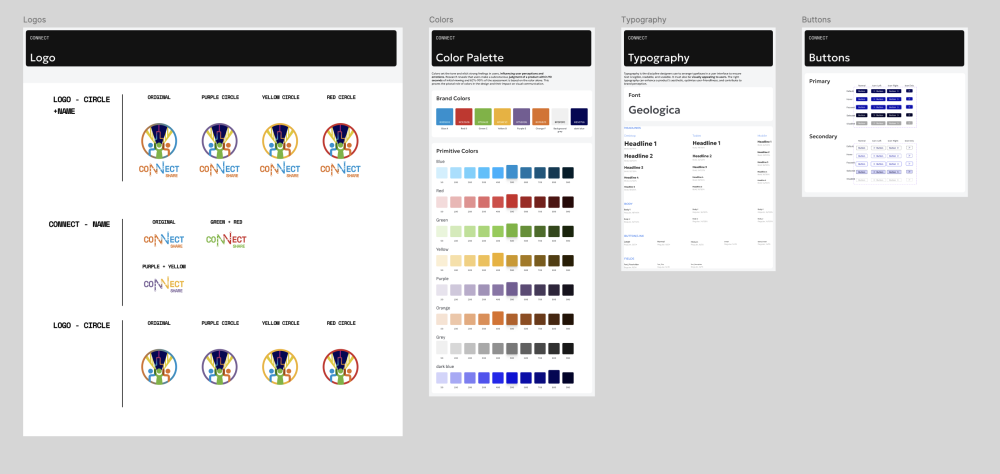
To ensure a consistent user experience and streamline the development process, our project is built upon a custom-developed, comprehensive Design System. This serves as the central framework for all visual and functional interfaces within our web application.
Importance of the Design System for our Project
A unified design system is essential to the success of our product for the following reasons:
- Consistency: Users can recognize the brand instantly. A cohesive appearance builds trust and conveys professionalism.
- Development Efficiency: By defining reusable components, there is no need to “reinvent the wheel” for every new feature.
- Scalability: New functions can be integrated seamlessly because design rules (layout grids, spacing, colors) are already established.
- Accessibility: By strictly defining contrasts and font sizes, we ensure that the application remains accessible to all target groups.
Core Components of our Style Guide
Color Palette
Our color strategy is deeply rooted in the application's functionality.
- Contextual Derivation: The primary colors and their respective shades were derived directly from metro line branding. This ensures high recognition and creates an immediate visual link to the urban mobility context.
- Color Hierarchy: We utilize a system of primary, secondary, and accent colors, complemented by a grayscale palette for backgrounds and text to effectively manage visual hierarchy.
Typography
- Typographic Scale: We use a fixed scale for font sizes, line heights, and weights.
- Application: This scale is applied consistently across all touchpoints from large headlines for orientation to optimized body text for detailed information. This guarantees a harmonious typographic appearance on all devices.
UI Component Library
A key part of the system is the library of reusable elements:
- Modularity: All elements, such as buttons and input fields, were developed modularly.
- Optimization: Components are specifically optimized for web application requirements (e.g., clear click targets, feedback states like hover or disabled).
- Reusability: Developers can easily access these components, which reduces the margin for error and seamlessly translates the design into the technical implementation.
The Design System forms the visual foundation of our project. It bridges the gap between aesthetic brand identity and technical precision, ensuring that the web application is perceived as a unified, professional, and cohesive piece of work.
Two-Step Marketing Communication Strategy

To build a sustainable brand identity, we are pursuing a two-step communication strategy. The objective is to transition the brand from purely text-based recognition toward iconic symbolic power.
Phase 1: Awareness & Literacy (Initial Phase)
During the launch phase, the focus lies on establishing brand awareness. As the project and the brand are new to Porto’s urban landscape, we will exclusively utilize the full wordmark (full logo).
Implementation: The merged “n” symbol is always presented in combination with the complete “connect” logotype.
Objective: The target audience should develop a cognitive link between the abstract symbol and the brand name. During this stage, commuters “learn” what the symbol represents. Readability is prioritized to eliminate communication barriers.
Phase 2: Iconic Recognition & Symbolism (Establishment Phase)
Once a critical mass of interactions and visual touchpoints has been achieved, the transition to de-branded symbolic communication takes place.
Implementation: The “connect” logotype is removed. The merged “n” stands as a solitary icon—featured on digital screens, projections on platform walls, or physical floor markings within the metro.
Psychological Effect: This step leverages the effect of visual saliency. The symbol has become so deeply embedded in the users' visual memory that the brand name is implicitly associated without being read.
Advantage: Reducing the brand to a pure symbol makes it appear less like traditional advertising and more like an integrated component of the digital art itself. It fosters curiosity and underscores the project’s minimalist, artistic ambition.
4.7. Marketing Programmmes
Whilst the strategy (section 4.6) defines what we aim to achieve, the marketing programme describes how we will put this into practice. This is the translation of our 4Cs into a concrete action plan.
4.7.1 Programmes (Action Plan)
Our marketing programme for the launch of CONNECT and share is divided into three concrete action pillars during a three-month pilot phase:
- Physical Installation (Customer Value & Convenience): In collaboration with engineers from ISEP and Metro do Porto, we are equipping one specific, heavily used metro line (the pilot line) with our sensor-equipped handrails and LED ceilings. This requires no extra effort from passengers, as we are integrating the technology into their existing routine.
- Guerrilla Marketing & Station Promotion (Communication): We avoid traditional, loud advertising. Instead, we place minimalist, intriguing posters, flyers and floor stickers in the metro stations along the pilot line. This arouses curiosity just before passengers board the metro.
- Digital Launch & Storytelling (Phase 2): Activating the QR codes near the metro doors. To encourage adoption, we launch an organic social media campaign (focused on Instagram and TikTok). Here, we will share the most beautiful, most inspiring ‘life lessons’ (messages) left via the QR code anonymously on a weekly basis. This creates a viral, emotional effect (Emotional Branding) and motivates others to share their stories too.
4.7.2 Budget
As CONNECT and share is a social marketing initiative operating within a Business-to-Government (B2G) model, the budget is not funded by the end user, but through public funds, ISEP, grants and Metro do Porto. The estimated costs are based on the list of materials in deliverables. The marketing and operational budget for the pilot phase is allocated as follows:
- R&D and Hardware (Largest cost item): The hardware for a single carriage deployment totals approximately €730 (as detailed in the initial cost analysis, Section 3.3.1). This covers all core components including microcontrollers, enclosures, pressure sensors, LED strips, and supporting electronics.
- Digital Infrastructure: Currently €0. Hosting the Phase 2 web platform via Vercel and Supabase falls within free tiers for a pilot-scale deployment. Should the platform be formally launched or scaled to additional lines, monthly costs are estimated at €50–100 or more.
- Promotional materials: €150–300. Design and printing of guerrilla marketing posters, QR code stickers, and flyers for stations along the pilot line.
- Maintenance & Management (Contingency): Est. 15% of hardware cost (≈€110). A reserved budget for repairs and component replacement.
Estimated total (pilot phase): €1000–1200
4.7.3. Control
To ensure the success of the marketing strategy, a structured monitoring plan is needed. This plan focuses on tracking progress, evaluating effectiveness and making adjustments where necessary. To achieve our marketing goal, the Plan-Do-Check-Act (PDCA) cycle will be used, as illustrated in Figure 8.

The control phase is divided into the following key elements:
Key Performance Indicators (KPIs)
We will measure the impact of the marketing program through four main categories:
- Interaction Rate: Number of activations per handle per hour to measure the physical engagement of the passengers.
- Behavioural Impact: Qualitative and quantitative measurement of the increase in eye contact and reduction of screen time, targeting from 30 to 60 seconds without looking at the phone.
- Content Growth: Number of new anonymous contributions submitted via QR codes, aiming to establish a solid baseline engagement rate during the first 30 days.
- Campaign Reach: Data from QR code scans on posters and flyers to analyze the visibility of the promotion.
- User Satisfaction: Qualitative feedback collected via digital surveys to evaluate their experience.
Continuous Improvement
Following the PDCA cycle shown above, the marketing team will be responsible for keeping an eye on these numbers. If a campaign or a specific poster location doesn't reach enough people, the message or channel will be changed. If the interaction works better than expected, it will be expanded to other metro lines. This constant feedback ensures that the project adapts to the passenger behavior and situational needs in real time.
4.8. Summary
CONNECT functions as more than a technological installation; it is a strategic social marketing intervention designed to enhance urban wellbeing in Porto. By addressing the macro-trend of digital isolation through a stakeholder-centric 4Cs framework, the project delivers superior value while fostering 'Zero-Friction Socialising.' This approach redefines the commute, transforming it into a mindful experience that reinforces Metro do Porto’s identity as a 'Smart City' leader and reclaims the social dimension of the urban environment.
To ensure this impact remains enduring, such social value must be synchronized with environmental and economic responsibility. Consequently, the following chapter details our eco-efficiency measures, exploring how life cycle assessments and circular economy models minimize the project’s ecological footprint while maximizing its potential for sustainable development.